May062015
Posted at 2:00 PM
Guest blog post by Avery Sen, PhD, National Oceanic and Atmospheric Administration
It is the mission of the Department of Commerce to make America more innovative; we collect and distribute information vital to businesses, we develop and commercialize new technologies, we make sure that our economy is a part of — not apart from — the ecosystems of this planet. But how do we improve the conduct of our own mission? This question is particularly relevant, given that the Department’s strategic plan prioritizes operational excellence in order to best support our customers — businesses, government and the American people — by building a learning organization.
This was the focus of the UnConference, a day-long event organized by the Leadership and Innovation Network at Commerce (LINC). About 50 people from across the Department participated, including staff from the Bureau of Economic Analysis, the Census Bureau, the National Oceanic and Atmospheric Administration, the National Institute of Standards and Technology, and the Patent and Trademark Office. As the chair of LINC’s Innovation and Technology Committee, I organized the UnConference as an opportunity for Commerce Department staff to get specific about what innovation means, discuss how it happens (or doesn't), draw out important issues, and ultimately develop a LINC agenda for promoting innovation within the department.
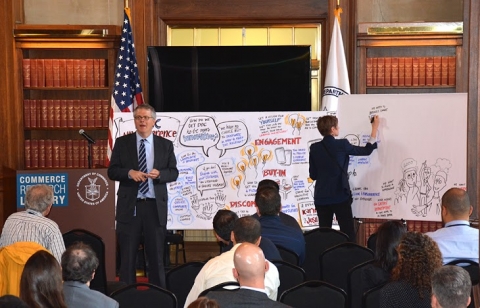
Deputy Secretary of Commerce Bruce Andrews delivered a very inspirational keynote address at the event. “Today’s unconference is the first event of its kind here at the Department of Commerce,” he said. “Created by our employees for our employees, this conference is proof positive of the passionate, professional, and pioneering spirit that resides within our Department.” Deputy Secretary Andrews also gave us a clear call to action: “Let’s tap into our full potential by rewarding creativity, not limiting it.”
Motivating the UnConference were the results of the most recent Federal Employee Viewpoint Survey. The government-wide innovation index was only 59 percent last year – down four points since 2010. (Commerce ranked in the top three most innovative large agencies, behind only NASA and the State Department). Just over half of federal employees feel encouraged to come up with new ways to do their work, and less than a third believe they are rewarded for their creativity and innovation. We, as federal employees, are not always incentivized to work across bureaus, take risks, experiment, or find new, innovative ways of improving mission delivery.
The UnConference gave folks a chance to take initiative and reverse this trend. In fact, what made the event an UnConference — and not a normal conference — was that the topics of discussion were determined by the attendees (not by the organizers) in a grass-roots fashion. Using the internal Ideas Tool within the Department’s intranet, topics were solicited, proposed, commented on, voted on, and chosen by the LINC community.
At the center of the event framing all the discussions was the following conversation focus proposed by LINC: The world is changing around us. It is inevitable. And for a federal agency to stagnate within an evolving environment is to do a disservice to the public trust. We must innovate not only to lead, but also to keep up. In this sense, innovation really isn’t a choice at all. The question is thus, how do we get [the Commerce Department] to be more innovative?
The day began with an armchair discussion between Josh Mandell, the Secretary’s Senior Advisor for Innovation and Competitiveness, and Karina Homme, Principal Program Manager for Microsoft Azure Government. They addressed a number of difficult issues head on: How can large organizations "pivot?" How do we balance our desire for consistency/reliability of public services with the changes that we have to make? How do you innovate when you don't control all of the variables? Do we ever really control all of the variables?
For the main part of the day, we had a dozen 30-minute, face-to face, no-PowerPoint conversations led by Commerce staff on topics such as retirement and retention in the federal workforce, using the Baldrige Excellence Builder to improve operations, using human-centered design to build innovation in government, and the role of government lawyers in innovation. We had a good crowd of really engaged folks talking passionately with one another about what it means for the department to be more innovative.
To sum up our discussions: measures matter, relationships matter, culture matters, shared tools matter, how we are organized matters – a lot of things matter beyond technology. Innovation isn't only about our outputs: information, technology, science. It is about our organization, our people, our meetings… how effectively we communicate and cooperate. As one scholar on the management of innovation has pointed out, innovation is not an individual activity; it is a collective achievement.[1]
What’s next? We will be collecting all of our materials (notes, the write-ups from discussion leads, as well as graphic recording of plenary and panel session) to draw conclusions and make recommendations to department leadership in a white paper. We also want to get moving on some of the ideas generated in the last session of the day – what can we do, what can we build together (beyond writing a paper) to make the department more innovative.
The UnConference is just one of a number of efforts that the Department is initiating to stimulate innovation and deliver on the operational excellence pillar of the Department’s “Open for Business Agenda.” Earlier this year, the Ideas Tool was launched as an online platform for Commerce employees to share their innovative ideas with senior leadership. There are also plans to start up an Idea Lab – which will give teams of employees the chance to define problems, experiment with prototype solutions, and pitch those solutions for further consideration.
[1] Van de Ven, A. H. (1986) ‘Central problems in the management of innovation’, Management
Science, 32/5: 590-607.