Jan272015
Posted at 6:17 PM
Guest Blog post by Emilia Istrate, PhD, Director of Research and Outreach, National Association of Counties
County economies are the building blocks of regional economies (metropolitan areas and micropolitan areas), states and the nation. County governments ensure the functioning of these fundamental units of the U.S. economy by building and maintaining basic infrastructure assets, keeping communities healthy and safe and providing the social safety net for those in need. Counties invest almost $500 billion annually in the services provided to their residents and local communities.
To better understand the dynamics within each county economy, the National Association of Counties (NACo) released earlier this month the 2014 County Economic Tracker: Progress through Adversity, an analysis of the recovery patterns across the 3,069 county economies in 2014. The conditions of a county economy can constrain and challenge county governments, residents and businesses, while also providing opportunities.
The full analysis can be found at www.naco.org/countyeconomies. To access the companion interactive maps and the individualized county profiles, go to NACo’s County Explorer interactive map at www.naco.org/countyexplorer. The January update of NACo’s interactive tool features the economic data from the County Economic Tracker analysis.
The 2014 County Economic Tracker analyzes annual changes of four economic performance indicators— economic output (GDP), employment, unemployment rates and home prices — between 2013 and 2014 across the 3,069 county economies. In addition, it explores 2012-2013 wage dynamics, taking into account the effect of local cost-of-living and inflation on average annual wages in county economies.
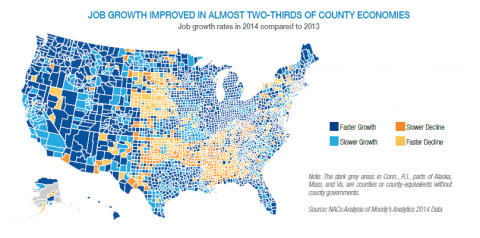
We saw significant growth in 2014. The economic output (GDP) in 55 percent of all county economies recovered or did not decline over the last decade. Home prices were in a similar situation. Job growth accelerated and 63 percent of county economies witnessed faster job gains than in 2013. This job growth helped unemployment decline in almost all county economies during the last year. However, there is still work that needs to be done to help the economy recover to pre-recession levels, when it comes to unemployment rates.
The economic recovery is starting to spread.
By 2014, almost three-quarters of county economies recovered to pre-recession levels by at least one of the indicators analyzed (economic output (GDP), employment, unemployment rates and home prices). For the first time, one large county economy (Kent County, Mich.) out of the 124 large county economies reached its pre-downturn unemployment rate. Sixty-five (65) county economies recovered on all four indicators by the end of 2014. The majority of the fully recovered county economies are small, with less than 50,000 people. Most of them have booming energy and agriculture sectors (in states such as Alaska, Kansas, Montana, North Dakota or Texas).
Counties are striving to provide high quality services to their residents and create a favorable investment climate. Many counties are sponsors of local economic development initiatives. Eighty-one (81) percent of all counties invest in economic development partnerships. Workforce challenges are at the top of the county economic development agenda. Maintaining a resilient economy with a diversified and competitive business environment is also a significant concern for counties. Counties own 45 percent of the public roads and more than 230,000 bridges. As major owners of infrastructure, counties deal directly with infrastructure challenges that affect the development and competitiveness of their local economies.
Together with academic and private sector partners, counties of all sizes work to create the right investment environment. Large counties have developed initiatives such as Franklin County, Ohio’s Smart Works investment program and Hillsborough County, Fl.’s Competitive Sites program. Mid-sized counties, such as Hamilton County, Tn., turned a decommissioned U.S. Army ammunitions plant into an industrial park that already houses Volkswagen and some of its suppliers. Small counties, such as the Pontotoc, Union, and Lee counties in Mississippi — which comprise the PUL Alliance — succeeded in turning an area affected by the decline of the furniture manufacturing into an auto manufacturing zone, anchored by a Toyota plant. And these are just a few examples of the work and projects that counties are developing with a network of public, nonprofit and private partners.
Collaboration is key to successful economic development. That’s why the local-state-federal partnership with the private sector and the nonprofits working on economic development needs to continue to secure the progress of the economy across the country.
Note: The County Economic Tracker 2014 used a variety of a data sources, both private data from Moody’s Analytics and public, including Census Bureau Population Estimates 2013, Gross Median Rent 2012 and 2013 from ACS 5 year estimates, U.S. Bureau of Economic Analysis 2012 Regional Price Parities, and U.S. Bureau of Labor Statistics QCEW wage data.