May142015
Posted at 3:09 PM
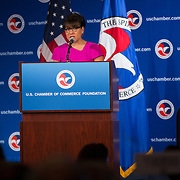
This week, Secretary Pritzker delivered the keynote speech at the Global Supply Chain Summit hosted by the U.S. Chamber of Commerce. The event gathered business leaders and supply chain experts to discuss the biggest supply chain challenges facing U.S. manufacturers, opportunities for supply chain innovation, and efforts to better unite the public and private sector to enhance supply chain processes.
During her remarks, Secretary Pritzker highlighted the need to strengthen supply chains in order to keep U.S. businesses competitive in the 21st century and help American manufacturers of all sizes to be successful. Efficient and effective supply chains are essential to promoting and selling U.S. goods and services to the 96 percent of customers who live beyond U.S. borders. Successfully connecting U.S. businesses to global markets will require the close cooperation, coordination, and partnership of both the public and private sectors.
Secretary Pritzker shared the Obama Administration’s holistic approach to improving supply chain’s competitiveness which focuses on three key areas: innovation, infrastructure, and border management. To stay at the forefront of global production, innovation is an absolute necessity for the small and medium-sized manufacturers that power the U.S. supply chain. The government can be a key partner in innovation, serving as a convener and as a catalyst. The Commerce Department already offers several initiatives that support innovation and empower U.S. manufacturers such as the Manufacturing Extension Partnership, which deploys experts nationwide to assist manufacturers in improving their processes, adopting new technologies, and taking new products to market.
Infrastructure is another crucial challenge to address and is key to supporting global supply innovation. Investments must be made in U.S. infrastructure including updating ports with 21st century technology, upgrading bridges, roads, and waterways to world-class standards, providing companies and their customers access to broadband, and supporting flexible and reliable logistics to move materials around the country. To highlight the importance of investing in America’s infrastructure, this week the Department of Commerce and U.S. Chamber of Commerce are supporting the third annual “Infrastructure Week” with more than 80 other organizations.
To address the challenge of border management, Secretary Pritzker also announced the program “Single Window,” which will go through a pilot test this summer. “Single Window” is an electronic portal designed to handle all import-export documents and processes with greater efficiency. This program will simplify the import-export system, to speed goods to market, and improve the experience of businesses at our borders. “Single Window” is a joint effort between the Commerce Department, Department of Homeland Security and the Administration. Secretary Pritzker encouraged participation from private sector partners to provide feedback on the Administration’s supply chain initiatives across-the-board.
Throughout the summit, several panels were held to address the toughest challenges facing supply chains and manufacturers including: how supply chains impact business processes, modernizing global borders for the 21st century, the challenges small and medium sized businesses face when connecting to the global economy, how e-commerce affects supply chains, and addressing security risks in the supply chain. Panelists represented a wide range of interest groups including large U.S. businesses, small manufacturers, and government officials. Attendees walked away with a call-to-action to better engage across public-private sectors and collaborate to support supply chain innovation, infrastructure and border management for the 21st century.